

Dividend Aristocrats - A Guide to Consistent Income
Article last updated: September 10, 2026

"Dividend Aristocrat" is not a compliment a company awards itself. It is a rules-based classification with a single demanding hurdle: raise the dividend every year for at least 25 consecutive years, without exception, through recessions and bad quarters alike. That requirement is what makes the group interesting to income investors, and what makes membership so easy to lose.
Key takeaways
- Dividend Aristocrats are companies in the S&P 500 that have increased their dividend every year for at least 25 consecutive years.
- To qualify as a Dividend Aristocrat a company must be an S&P 500 constituent, have a 25-year record of consecutive annual dividend increases, and meet the index's minimum size and liquidity requirements.
- A company loses Dividend Aristocrat status if it cuts its dividend, merely holds it flat for a year, or drops out of the S&P 500.
- The S&P 500 Dividend Aristocrats index is equally weighted rather than weighted by market capitalisation, so each member contributes roughly the same amount to its return.
- Dividend Aristocrat status describes a company's dividend history, not its valuation or its future, so a long increase streak is a starting filter rather than a buy signal.
What are Dividend Aristocrats?
Dividend Aristocrats are companies in the S&P 500 that have raised their dividend every year for at least 25 consecutive years. The term refers to the constituents of the S&P 500 Dividend Aristocrats index, which applies that rule mechanically rather than by judgement.
The 25-year requirement is a stringent filter because it spans multiple recessions. A company that has raised its dividend through every one of them has demonstrated durable earnings, conservative payout policy and a management culture that treats the dividend as a commitment rather than a discretionary payment.
Dividend Aristocrats tend to cluster in mature, cash-generative sectors: consumer staples, industrials, healthcare and utilities. Businesses in fast-changing industries rarely accumulate a 25-year streak, because their earnings are less predictable and their capital is usually better spent on growth.
What are the criteria to be a Dividend Aristocrat?
A company must meet three requirements to be a Dividend Aristocrat: membership of the S&P 500, at least 25 consecutive years of annual dividend increases, and the index's minimum size and liquidity thresholds.
- S&P 500 membership. The company must be a constituent of the S&P 500. A company with a 40-year dividend growth record that is not in the S&P 500 is not a Dividend Aristocrat, however impressive its history.
- 25 consecutive years of dividend increases. The dividend per share must have increased in each of the last 25 years. Maintaining the dividend unchanged for a single year breaks the streak just as decisively as cutting it.
- Size and liquidity. The company must meet the index's minimum float-adjusted market capitalisation and average daily trading value requirements, which exist to keep the index investable.
The index has additional construction rules, including a minimum number of constituents and limits on how concentrated it can become in any one sector. Membership is reviewed annually, with the index rebalanced during the year, so the list changes as companies qualify and fall out.
How does a company lose Dividend Aristocrat status?
A company loses Dividend Aristocrat status the moment it fails to increase its dividend for a year, cuts its dividend, or ceases to be an S&P 500 constituent. There is no probation period and no partial credit.
The strictness cuts both ways. It is what gives the label meaning, and it is also why a company under pressure may keep raising its dividend by a token amount rather than accept removal, which is not necessarily in shareholders' interests. A dividend raised by a cent to protect a streak while earnings fall is a signal to check the dividend payout ratio, the share of earnings the dividend consumes.
Once lost, status can only be regained by starting a fresh 25-year streak. In practice, removal from the index is permanent for a generation.
Are Dividend Aristocrats a good investment?
Dividend Aristocrats have historically delivered index-like returns with somewhat lower volatility, which suits investors who value income stability more than maximum growth. The trade-off is real but modest, and the label alone says nothing about whether a given company is attractively priced today.
The case in favour is that a 25-year dividend growth record is a durable quality screen. Companies that clear it have proven earnings resilience across cycles, and their rising dividends mean a long-term holder's yield on cost, the income measured against what they originally paid, climbs year after year.
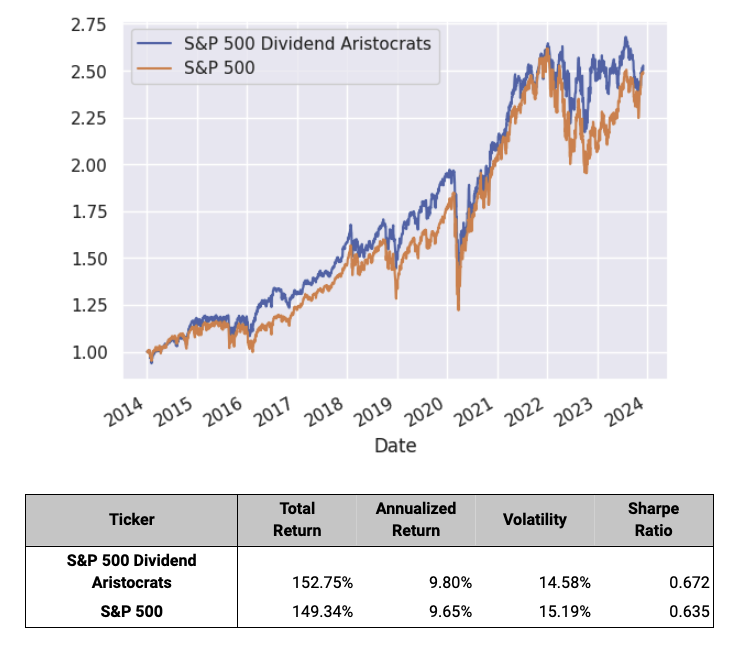
Source: Data from Yahoo Finance
Over the period covered by the chart above, the annual return of the Dividend Aristocrats index since inception was 9.8%, compared with 9.65% for the S&P 500, with lower volatility of 14.58% against the S&P 500's 15.19%. That combination gives the Dividend Aristocrats index a marginally higher Sharpe Ratio, which measures return per unit of volatility, though the difference is not large enough to be decisive. These figures cover the period shown in the chart and will shift as further years are added.
The case against is worth stating plainly:
- The screen is backward-looking. A 25-year streak describes the past. It does not guarantee a 26th increase.
- Sector concentration. Because few technology companies qualify, a Dividend Aristocrats portfolio is structurally underexposed to the sector that has driven much of the market's recent growth.
- Valuation is ignored. The index selects on dividend history alone, so a member can be expensive and still be included.
- Streak protection. Membership creates an incentive to keep raising the dividend, even when retaining the cash would serve the business better.
How can I invest in Dividend Aristocrats?
Investors access Dividend Aristocrats either through an exchange-traded fund that tracks the index or by buying individual constituent companies directly. Both routes hold the same underlying businesses; they differ in cost, diversification and effort.
The ProShares S&P 500 Dividend Aristocrats ETF (NOBL) is designed to track the performance of S&P 500 companies with a history of consistently increasing dividends. A single purchase gives exposure to the whole equally weighted group, which removes the risk that any one company cuts its dividend and damages your income. The cost is an expense ratio and no control over which members you own.
Buying individual Dividend Aristocrats gives control over sector mix, valuation and position sizing, at the cost of research and monitoring. If you take that route, assess each company on its own financial health, industry position and growth prospects rather than on the label, and check the dividend yield you are actually buying, since index membership says nothing about price.
Which stocks were added to the Dividend Aristocrats in 2023?
The list of Dividend Aristocrats is revised regularly, with both additions and removals. In the February 2023 adjustments, Nordson Corp. (NDSN), CH Robinson Worldwide Inc. (CHRW) and JM Smucker Co. (SJM) were added, and the list expanded further in August 2023 with the addition of Kenvue.
In the same year, VF Corp (VFC) and AT&T (T) were removed. Both companies reduced their dividends, which ends a Dividend Aristocrat streak immediately and triggers exclusion from the index.
The changes above describe 2023 only. Because membership is reviewed each year, the current constituent list will differ, and the index provider's published methodology and fact sheet are the authoritative source for who is in it today.
Dividend Aristocrats vs Dividend Kings vs Dividend Achievers
Dividend Aristocrats, Dividend Kings and Dividend Achievers are three dividend-growth classifications that differ in the length of the streak required and in which companies are eligible.
| Classification | Streak required | Eligible universe |
|---|---|---|
| Dividend Achievers | 10+ consecutive years of dividend increases | Broad US listed companies |
| Dividend Aristocrats | 25+ consecutive years of dividend increases | S&P 500 constituents only |
| Dividend Kings | 50+ consecutive years of dividend increases | US listed companies, S&P 500 membership not required |
Dividend Kings clear the longest streak but are not restricted to the S&P 500, so the two groups overlap without either containing the other. Dividend Achievers is the widest of the three and includes younger dividend growers that have not yet built a 25-year record. Related indices apply similar rules to mid-cap and small-cap universes with shorter streak requirements.
Frequently asked questions
Do Dividend Aristocrats have high dividend yields?
Not necessarily. Dividend Aristocrat status is awarded for consecutive years of dividend increases, not for the size of the dividend, and many members yield around or below the market average. A company that has raised its dividend for 25 years has usually also seen its share price rise, which keeps the dividend yield modest even as the payment grows.
Can a company be a Dividend Aristocrat if it kept its dividend flat for one year?
No. The requirement is an increase in every one of the past 25 years, so a single year at an unchanged dividend ends the streak and removes the company from the index. This is stricter than the common assumption that only a dividend cut disqualifies a company. Rebuilding eligibility means starting a new 25-year record from scratch.
Are there Dividend Aristocrats outside the United States?
Yes. Index providers publish regional equivalents, including European, Canadian and pan-Asian dividend aristocrat indices. Their rules differ from the US version and typically require shorter streaks, often 7 to 10 years of maintained or increased dividends, because fewer non-US companies have 25-year records of annual increases.
Should I buy the Dividend Aristocrats ETF or the individual stocks?
An ETF tracking the index suits investors who want the whole group without per-company research, accepting an expense ratio and no control over holdings. Buying individual members suits investors willing to research each business and who want to select on valuation or sector. The underlying companies are the same in both cases.
How to track a dividend growth portfolio in Portseido
A dividend growth strategy is only worth running if you can see whether the income is actually growing, and that is difficult to judge from brokerage statements alone. Portseido keeps a dividend income history for every holding, so you can see received income year by year, and reports yield on cost next to current dividend yield, which is where a long dividend growth record shows up as a number. It consolidates positions across multiple brokers and currencies, and can benchmark the portfolio against an index or ETF if you want to test a dividend growth portfolio against the broad market.
Portseido tracks and reports on your portfolio; it does not screen for Dividend Aristocrats and does not give buy or sell recommendations. There is a free plan, and paid features come with a 14-day trial that does not need a credit card. Try Portseido free