

Return on Capital Employed (ROCE) - Definition, Formula & Example
Article last updated: September 10, 2026

Return on Capital Employed (ROCE) is a profitability ratio that shows how much operating profit a company produces from every unit of long-term capital it uses. It is a favourite of investors who care about business quality, because a company that can reinvest at a high ROCE compounds its own capital without needing to raise more.
Key takeaways
- Return on Capital Employed (ROCE) measures a company's efficiency at converting the capital it uses into operating profit, expressed as a percentage.
- ROCE is calculated as earnings before interest and taxes (EBIT) divided by capital employed, where capital employed is shareholders' equity plus non-current liabilities.
- A higher ROCE indicates a company generating more profit per unit of capital, and a ROCE consistently above the company's cost of capital is the sign that the business creates value.
- ROCE differs from ROE, which uses only shareholders' equity, and from ROIC, which uses interest-bearing debt rather than all non-current liabilities.
- ROCE is built on book values, so it flatters companies with old, heavily depreciated assets and penalises those carrying large goodwill from acquisitions.
What is Return on Capital Employed (ROCE)?
Return on Capital Employed, or ROCE, is a financial metric that measures a company's efficiency in using its capital to generate profit. The higher the ROCE, the more operating profit the company squeezes out of each unit of capital it employs.
Capital employed means the long-term funding the business runs on: the money shareholders have put in and left in, plus long-term borrowings and other non-current liabilities. It excludes short-term operating liabilities such as trade payables, on the grounds that those are a by-product of trading rather than capital anyone had to supply.
Because ROCE is measured before interest, it is indifferent to how the business is financed. That makes it a cleaner comparison across companies with different debt levels than return on equity, which flatters companies simply for borrowing more.
How is ROCE calculated?
ROCE is calculated by dividing earnings before interest and taxes (EBIT) by capital employed, which is the sum of shareholders' equity and non-current liabilities.
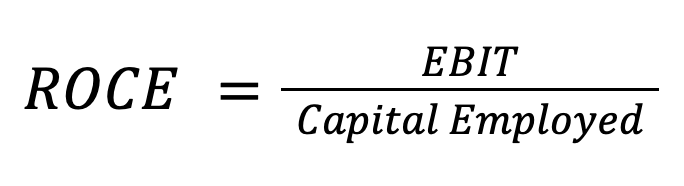
ROCE = EBIT / Total Capital Employed

Total Capital Employed = Shareholders' Equity + Non-Current Liabilities
Where EBIT is earnings before interest and taxes for the period, and Total Capital Employed is the sum of shareholders' equity and non-current liabilities at the beginning of the period.
Two conventions matter when calculating ROCE:
- Use opening capital employed. ROCE asks how much profit was generated from the capital the business started the period with, so take the balance sheet figures from the beginning of the period. Some analysts average the opening and closing figures instead; either is defensible, provided you are consistent when comparing companies.
- Use EBIT, not net income. EBIT sits above the interest and tax lines, which keeps the numerator independent of the company's financing mix and tax jurisdiction.
A simple ROCE example
A company that earned EBIT of $40 million during a year, having started that year with $120 million of shareholders' equity and $80 million of non-current liabilities, has a ROCE of 20%.
Total Capital Employed = 120 + 80 = 200
ROCE = 40 / 200 = 20%
Every $100 of long-term capital in that business produced $20 of operating profit over the year.
ROCE calculation example using real financial statements
Apple's 10-K filing for the 2022 financial year reports EBIT of $119,437 million, against shareholders' equity of $63,090 million and non-current liabilities of $162,431 million at the beginning of that financial year, giving a ROCE of 52.96%.
Because ROCE measures how efficiently a company used the capital it had available, the capital employed at the beginning of the period is the right figure to use.
Total Capital Employed = 63,090 + 162,431 = 225,521
ROCE = 119,437 / 225,521 = 52.96%
A ROCE near 53% means the business generated almost 53 cents of operating profit for every dollar of long-term capital it started the year with. Figures at that level usually reflect a business whose real assets are intangible — brands, software, customer relationships — because those do not sit on the balance sheet at anything like their economic value, which shrinks the denominator.
What is a good ROCE?
A good ROCE is one that comfortably exceeds the company's cost of capital, because a business earning less than it pays for capital destroys value even while reporting a profit. As a practical convention, many analysts treat a ROCE sustained above roughly 15% as the mark of a high-quality business, and below 10% as a signal to look harder at why.
Three qualifications matter more than the threshold:
- Compare within an industry. Utilities, telecoms and heavy manufacturing structurally report lower ROCE than software or consumer brands, so a 12% ROCE can be excellent in one industry and mediocre in another.
- Look at the trend, not the year. A single year's ROCE can be moved by an asset sale, an acquisition or a one-off charge. Five years of figures shows whether the efficiency belongs to the business or to the period.
- Check it is reinvestable. A high ROCE only compounds if the company can deploy more capital at a similar rate. A niche business earning 40% on a small capital base with nowhere to reinvest is a different proposition from one that can grow at that rate for a decade.
Why is ROCE important?
ROCE is important because it links profitability to the capital required to produce it, and that relationship determines whether growth actually creates value for shareholders. It serves three purposes for an investor:
- It measures capital efficiency. Two companies can report the same operating profit while one needed twice the capital to generate it. ROCE separates them.
- It supports comparison across companies. Because ROCE is calculated before interest, it compares operating performance across businesses with different capital structures more fairly than return on equity does.
- It frames the reinvestment case. A company with a high ROCE and genuine growth opportunities can reinvest its profits at that rate, producing higher profits and more capital to reinvest again. That loop is the mechanism behind long-run compounding, and it is why the decision to pay a dividend or retain earnings is really a question about ROCE.
ROCE vs ROIC (Return on Invested Capital)
ROCE and ROIC both measure capital efficiency, but they define the capital base differently: ROCE uses shareholders' equity plus all non-current liabilities, while ROIC uses shareholders' equity plus interest-bearing debt wherever it sits on the balance sheet.
The practical difference is what each includes:
| ROCE | ROIC | |
|---|---|---|
| Numerator | EBIT | Operating profit after tax (NOPAT) in most definitions |
| Debt included | All non-current liabilities | All interest-bearing debt, current and non-current |
| Excess cash | Included in the capital base | Usually excluded |
ROIC counts only the capital actually invested in operations. In Apple's case, invested capital would include term debt from non-current liabilities plus commercial paper and term debt from current liabilities, while excluding the cash pile that ROCE leaves in the denominator. For a cash-rich company, ROIC is usually the higher of the two figures.
ROCE vs ROA (Return on Assets)
ROCE and ROA differ in one respect: ROA measures profit against a company's total assets, while ROCE measures it against total assets less current liabilities. Return on Assets asks how much profit the business generates from everything it controls; ROCE narrows that to the capital that had to be funded long term, on the view that short-term operating liabilities such as trade payables come from the ordinary course of business rather than from investors. A company funding a large share of operations through supplier credit will therefore show a materially higher ROCE than ROA.
ROCE vs ROE (Return on Equity)
ROCE and ROE differ in what capital they hold the company accountable for: ROE measures profitability against shareholders' equity alone, while ROCE measures it against equity plus non-current liabilities. Because ROE ignores debt in its denominator and is calculated after interest, a company can raise its ROE simply by replacing equity with borrowing — a higher figure that reflects leverage rather than better operations, and carries the risk leverage brings. ROCE incorporates both equity and non-current liabilities, so it is harder to flatter through financing decisions.
What are the limitations of ROCE?
The main limitation of ROCE is that both of its inputs are accounting figures, so ROCE measures book efficiency rather than economic efficiency.
- Old assets inflate it. Property and equipment sit on the balance sheet at cost less accumulated depreciation, so a company running twenty-year-old factories shows a small denominator and a high ROCE without being more efficient than a competitor that just built new ones.
- Acquisitions depress it. Goodwill enters the capital base at full price, so an acquisitive company reports a lower ROCE than an identical business that grew organically.
- Intangibles are missing. Internally developed brands, software and research are expensed rather than capitalised, which removes them from the denominator and can push ROCE to levels that overstate the economics.
- Excess cash drags it down. Cash sits inside shareholders' equity but earns little operating profit, so a cash-rich company's ROCE understates the return on the capital actually working.
- It is a single-period snapshot. ROCE says nothing about growth, competitive durability or whether the return can be repeated on new capital.
Treat ROCE as one input to a judgement about business quality rather than a verdict on its own, and read it alongside cash flow, growth and whatever non-financial evidence you can gather about the business.
Frequently asked questions
Is a higher ROCE always better?
Not automatically. A very high Return on Capital Employed can reflect a genuinely efficient business, or an artefact of a small book capital base — heavily depreciated assets, expensed intangibles, or a company that leases rather than owns. Check whether the figure is stable over several years, and whether the company has room to reinvest at that rate, before treating it as a quality signal.
What is the difference between ROCE and profit margin?
Profit margin measures profit as a share of revenue, while ROCE measures profit as a share of the capital used to generate it. A supermarket can run a 3% margin and a respectable ROCE because it turns its capital over many times a year; a shipbuilder can post a high margin and a poor ROCE because each unit of capital produces revenue slowly.
Can ROCE be negative?
Yes. ROCE is negative whenever a company reports negative EBIT, meaning it lost money at the operating level before interest and tax. A negative ROCE says the business consumed capital rather than earning a return on it. This is common for early-stage companies and for established ones in a bad year, so the trend matters more than the single figure.
Where do I find the numbers to calculate ROCE?
EBIT comes from the income statement, usually reported as operating income. Shareholders' equity and non-current liabilities come from the balance sheet — and for this calculation you want the balance sheet at the beginning of the period, which is the prior year's closing balance sheet. Both statements appear in a company's annual report or 10-K filing.
How to track the companies you research in Portseido
Portseido is a portfolio tracker, not a fundamental analysis tool. It does not calculate ROCE or pull financial statement data. What it does is keep the position side in order once you have researched a company and bought it: consolidating holdings across brokers and currencies, tracking cost basis, dividends and yield on cost, calculating time-weighted and money-weighted returns, and benchmarking the portfolio against indices and ETFs.
That gives you one place to see whether the high-ROCE businesses you picked have actually rewarded you. Portseido tracks and reports on your portfolio; it does not give buy or sell recommendations. There is a free plan, and paid features come with a 14-day trial that does not need a credit card. Try Portseido free