

How to Calculate Portfolio Return?
Article last updated: September 10, 2026

Portfolio return measures how much an investment portfolio gained or lost over a period, expressed as a percentage of the amount invested. Four methods are in common use, and they differ in the data they need and the question they answer. Each is covered below with its formula, an example and the Excel steps.
Key takeaways
- Portfolio return is the gain or loss of an investment portfolio over a period, expressed as a percentage of the amount invested at the start.
- Holding period return is the simplest method: all gains over the period, including income and net of costs, divided by the initial portfolio value.
- Weighted average portfolio return multiplies each holding's starting weight by its return and sums the results, showing where the portfolio's return came from.
- Time-weighted return removes the effect of deposits and withdrawals, so it measures how the investments performed rather than when money was added.
- Money-weighted return, also called the internal rate of return, reflects the size and timing of every cash flow, so it measures what the investor personally earned.
What is portfolio return?
Portfolio return measures the gain or loss of an investment portfolio over a specified period, relative to the value invested at the start of that period. It is quoted as a percentage so portfolios of different sizes can be compared on the same basis.
Portfolio return is not the average of the returns of the holdings inside it. A holding worth 40% of a portfolio moves the result twice as much as one worth 20%, so weights matter as much as individual returns.
A portfolio return figure is only useful next to a reference point, so it is worth comparing your performance against a benchmark such as an index or ETF.
How do you calculate portfolio return?
Portfolio return is calculated using one of four methods: holding period return, weighted average portfolio return, time-weighted return, or money-weighted return. The right one depends on the data you have and on whether you want to strip out the effect of deposits and withdrawals.
| Method | Data you need | Best for |
|---|---|---|
| Holding period return | Start value, end value, income, costs | A single position, or a portfolio with no deposits or withdrawals |
| Weighted average portfolio return | Each holding's starting weight and its return | Seeing which holdings drove the portfolio's return |
| Time-weighted return | Portfolio value at every cash flow date | Judging investment performance independently of contribution timing |
| Money-weighted return | Every cash flow with its date, plus the ending value | Measuring the return you personally earned, timing decisions included |
The four methods give four different numbers for the same portfolio, and none of them is wrong. If you are unsure which to quote, the comparison of simple return, time-weighted return and money-weighted return sets out when each is the honest answer.
How do you calculate holding period return?
Holding period return (HPR) is calculated by taking all the gains made over the period, including income and net of related costs, and dividing them by the value of the portfolio at the start of the period.
Holding Period Return = (End Value - Initial Value + Income - Costs) / Initial Value
Gains include price appreciation plus income such as dividends, net of costs such as commissions. The initial value is what the position was worth at the start, which for a position bought during the period is its cost basis.
Holding period return formula

For example, if you bought AAPL at $175, received a $0.24 dividend and AAPL was valued at $200 at the end of the period, the holding period return would be (200 - 175 + 0.24) / 175 = 14.42%.
Holding period return is easy to compute but ignores when money went in, so a large mid-period deposit mixes the investment's performance with the timing of that deposit.
How to calculate holding period return in Excel
To calculate holding period return in Excel:
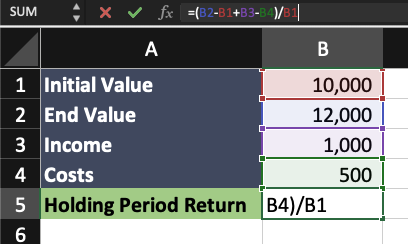
- Input End Value, Initial Value, Income and Cost into your Excel file
- Calculate the HPR as
= (End Value - Initial Value + Income - Cost) / Initial Value
How do you calculate weighted average portfolio return?
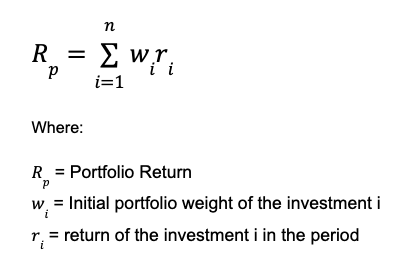
Weighted average portfolio return is calculated by multiplying each holding's share of the portfolio at the start of the period by that holding's return over the period, then adding the results together.
Weighted Average Portfolio Return = (Weight1 x Return1) + (Weight2 x Return2) + ... + (WeightN x ReturnN)
You need the portfolio weight of each investment at the beginning of the period, meaning its value as a share of the whole portfolio, and each investment's return.
For example, a portfolio that started the year 50% in a stock that returned 12%, 30% in a stock that returned 8%, and 20% in a bond fund that returned 2% has a weighted average portfolio return of (0.5 x 12%) + (0.3 x 8%) + (0.2 x 2%) = 8.8%.
Weighted average portfolio return formula
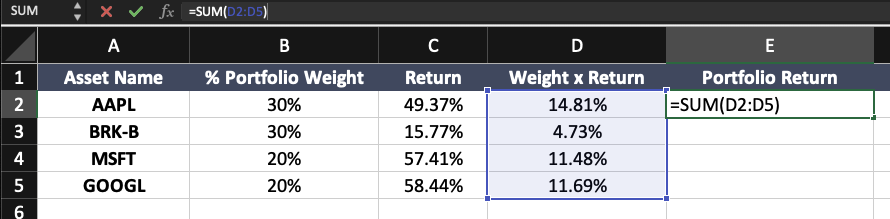
How to calculate weighted average portfolio return in Excel
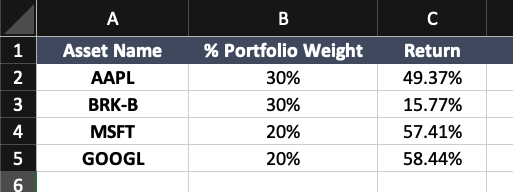
- Create the table with asset name, initial portfolio weight and return for each of them
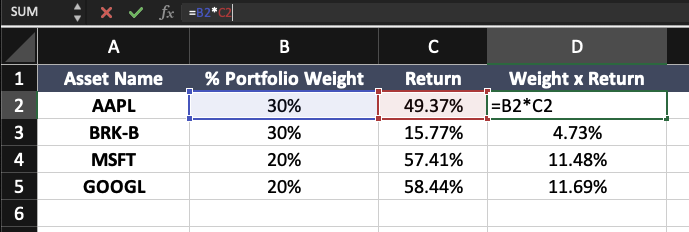
- Multiply the weight and return of each asset to get the return impact on the portfolio
- Sum the values to get weighted average portfolio return
How do you calculate time-weighted return?
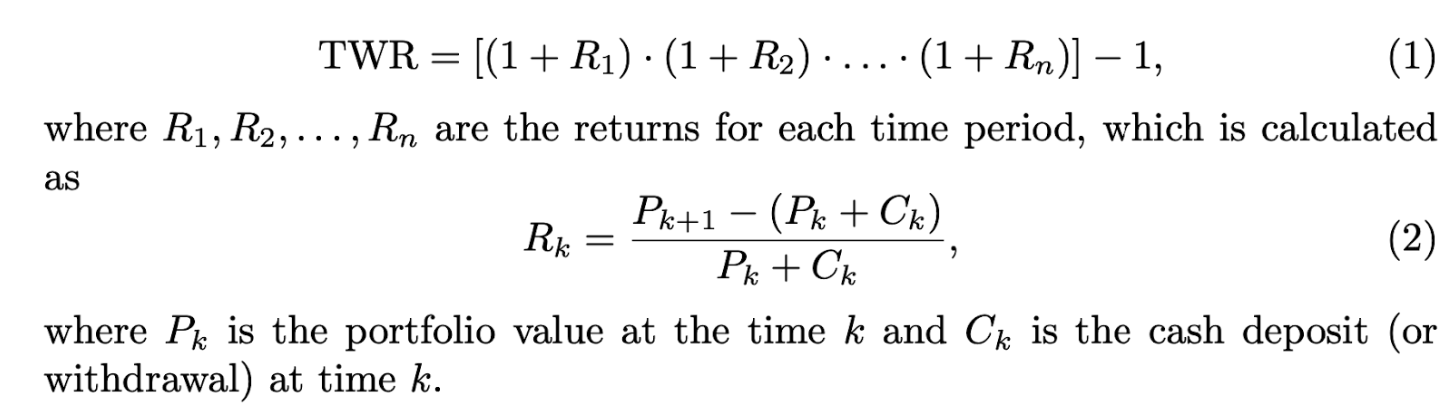
Time-weighted return (TWR) is calculated by splitting the period into sub-periods at every deposit or withdrawal, calculating the return of each sub-period separately, then chaining those returns together so each period counts equally regardless of how much money was invested at the time.
Sub-period Return = End Value / (Beginning Value + Cash Flow) - 1

TWR = [(1 + Return1) x (1 + Return2) x ... x (1 + ReturnN)] - 1
Because each sub-period counts equally, time-weighted return is unaffected by how much money was in the portfolio when it performed well or badly. That is why it is the standard for comparing fund managers, who do not control when clients deposit.
Time-weighted return formula
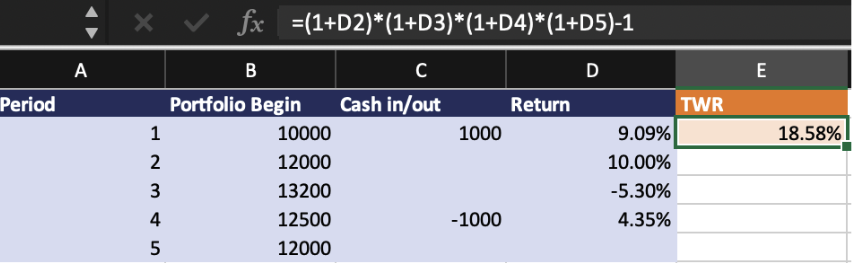
How to calculate time-weighted return in Excel
- Input the portfolio value at the start of each period and record any cash flows (inflows or outflows) during that period.
- Calculate the return for each sub-period as end value divided by beginning value plus cash flow, minus 1.
- Add one to each sub-period return, multiply them all together, then subtract 1 to obtain the TWR.
Alternatively, you can try calculating time-weighted return using our free TWR calculator.
How do you calculate money-weighted return?
Money-weighted return (MWR), also known as the internal rate of return (IRR) or dollar-weighted return, is the single rate of return that makes the present value of every cash flow into and out of the portfolio, plus the ending portfolio value, equal zero.
Money-weighted return formula
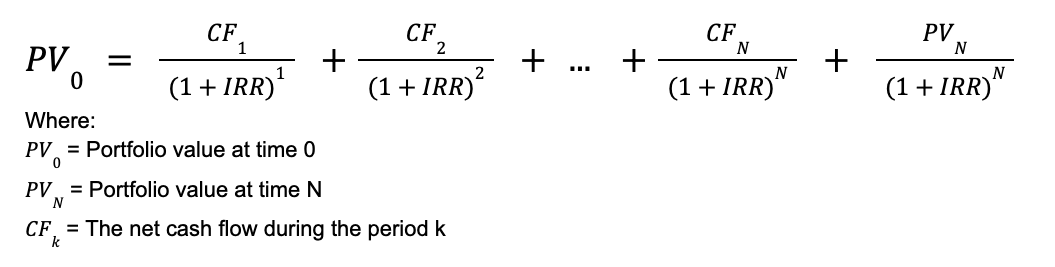
Money-weighted return counts the size and timing of cash flows, so a deposit made before a rally raises it and one made before a fall lowers it. It answers "what did I actually earn", while time-weighted return answers "how did the investments perform". Solving it by hand is impractical, so it is normally done in a spreadsheet.
How to calculate money-weighted return in Excel
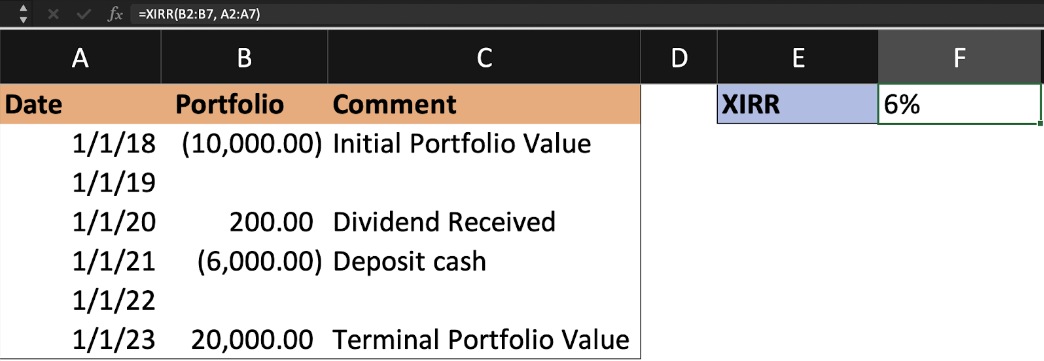
To calculate MWR in Excel or Google Sheets, use the XIRR function. Input the initial portfolio value and every cash flow with its date and size, and the function returns the rate of return that solves the equation. Mind the signs:
- Enter the initial portfolio value and every later contribution as a negative number, since that is money leaving your pocket.
- Enter dividends, withdrawals, sale proceeds and the final portfolio value as positive numbers.
Redoing an XIRR every time you deposit, receive a dividend or open an account at another broker is the part most investors abandon. Portseido calculates money-weighted and time-weighted returns from your transaction history automatically, across brokers and currencies, so the figure stays current without spreadsheet maintenance.
Alternatively, you can try our free MWR calculator.
Frequently asked questions
Do dividends count towards portfolio return?
Yes. Dividends are part of a portfolio's total return and should be added to the gains in whichever method you use. Excluding them understates the performance of income-paying holdings, sometimes substantially. In a holding period return calculation, dividends belong in the income term of the numerator, alongside any interest received.
Should portfolio return include fees and taxes?
Include the costs you actually paid, such as brokerage commissions and platform fees, by netting them off the gains. Portfolio return calculated this way is called a net return and reflects what you kept. Taxes are usually excluded because they depend on personal circumstances, but say which basis you used when comparing against a benchmark.
How do you turn a portfolio return into an annual figure?
Convert a multi-year portfolio return into an annualised figure with ((1 + Total Return) ^ (1 / Number of Years)) - 1. A portfolio that gained 40% over three years annualises to roughly 11.9% a year. Comparing a multi-year return against a one-year benchmark without annualising is a common reporting error.
Why do two calculators give different portfolio returns for the same account?
Different methods answer different questions, so they legitimately disagree. Time-weighted return ignores the size and timing of deposits, money-weighted return builds them in, and holding period return ignores intra-period cash flows entirely. Before comparing two figures, check that both use the same method, period and treatment of dividends.
How to track portfolio return in Portseido
Portseido calculates portfolio return from your transaction history, so you do not have to rebuild a spreadsheet each time you trade. It consolidates holdings across brokers and currencies, reports simple return, time-weighted return and money-weighted return side by side, tracks cost basis, dividends and yield on cost, and benchmarks the portfolio against indices and ETFs. The same data feeds monthly and dividend performance reports.
Portseido tracks and reports on your portfolio; it does not give buy or sell recommendations. There is a free plan, and paid features come with a 14-day trial that does not need a credit card. Try Portseido free