

Portfolio Weight - What is it? How to calculate?
Article last updated: September 10, 2026

Portfolio weight is the single number that tells you how much a holding actually matters to your portfolio. A stock that doubles is only good news in proportion to its weight, and a stock that halves only hurts in proportion to it. This guide covers what portfolio weight is, how to calculate it, what weights are reasonable, and why they drift.
Key takeaways
- Portfolio weight is the value of one position expressed as a percentage of the total value of the portfolio.
- Portfolio weight is calculated by dividing the market value of a position by the total market value of the portfolio, then multiplying by 100.
- The portfolio weights of every holding in a portfolio add up to 100%, so raising one holding's weight necessarily lowers the others.
- Portfolio weight determines how much a holding's return moves the portfolio: a 5% position that gains 20% adds only 1% to the total portfolio.
- Portfolio weights drift as prices move, so a position deliberately sized at 10% can become 20% after a strong run without you ever buying another share.
What is portfolio weight?
Portfolio weight is the percentage of a specific position or asset type in an investment portfolio, measured as that position's value divided by the total portfolio value. It indicates the extent of exposure the portfolio has to that particular asset.
Portfolio weight can be measured at any level of grouping. You can calculate the weight of a single stock, of an entire sector, of a currency, of an asset class, or of one broker account within your total holdings. The arithmetic is identical; only the definition of "the position" changes.
Portfolio weight matters because it converts a holding's return into portfolio impact. A holding at 40% of a portfolio moves the total twice as hard as one at 20%, regardless of how good either company is.
How do you calculate portfolio weight?
Portfolio weight is calculated by dividing the market value of a specific position by the total market value of the entire portfolio, then multiplying by 100 to express it as a percentage.
Portfolio Weight = (Asset Position Value / Total Portfolio Value) x 100
Portfolio Weight Formula:

Two rules keep the calculation honest. Use current market values rather than what you paid, because weight describes present exposure, not history. And value every position on the same date and in the same currency, or the weights will not add up to 100%.
Alternatively, you can use our free Portfolio Weight Calculator to calculate it for you.
Portfolio weight calculation example
A $12,000 position in a $50,000 portfolio has a portfolio weight of 24%, because 12,000 divided by 50,000 is 0.24.
Take a portfolio holding five things, valued on the same day:
| Holding | Market value | Portfolio weight |
|---|---|---|
| AAPL | $12,000 | 24% |
| MSFT | $9,000 | 18% |
| VOO (S&P 500 ETF) | $20,000 | 40% |
| Bond ETF | $6,000 | 12% |
| Cash | $3,000 | 6% |
| Total | $50,000 | 100% |
Working the formula, which is the position's value divided by total portfolio value, for the AAPL holding:
Portfolio Weight = ($12,000 / $50,000) x 100 = 24%
The weights sum to 100%, which is the check worth running every time. Notice what the table reveals: the S&P 500 ETF at 40% is the largest single exposure, and because that ETF also holds AAPL and MSFT inside it, the portfolio's true exposure to those two companies is higher than the 24% and 18% shown.
Can portfolio weight be measured in shares instead of value?
Yes, portfolio weight can be measured as a share of the total number of shares held, but the result answers a different and usually less useful question. Values are the standard basis.
A portfolio holding 500 shares in total, of which 100 are one company, has a share-count weight of 20% for that company. If those 100 shares trade at $10 and the other 400 trade at $200, the position is only $1,000 out of $81,000, a value weight of about 1.2%. The share count says 20%; the money at risk says 1.2%.
Share-count weight is occasionally useful for options and voting-rights questions. For measuring exposure, risk or performance contribution, use market value.
Why is portfolio weight important?
Portfolio weight is important because it determines how much risk and how much return each holding contributes to the portfolio as a whole. Three uses stand out.
- Risk management. Knowing the portfolio weight of each asset shows where concentration sits. Overweighting a single stock or sector means a downturn in that one place damages the whole portfolio disproportionately.
- Diversification. Portfolio weight analysis is how diversification is measured in practice. Counting holdings is not enough: a 20-stock portfolio with 45% in one name is far less diversified than the count suggests, which is why weight belongs alongside the question of how many stocks you should own.
- Performance attribution. Multiplying each holding's weight by its return shows which positions actually drove the portfolio's gain or loss. That calculation is the basis of the weighted average method of calculating portfolio return.
Keeping weights current means revaluing every position, in every account and currency, every time prices move. Portseido consolidates holdings across brokers and currencies and shows the weight of each position and asset class in the combined portfolio, so the concentration you actually carry stays visible without a spreadsheet.
What is a good portfolio weight for a single stock?
Most individual investors cap any single stock at 5% to 10% of the portfolio, a band that limits the damage from one company failing while still letting a good position matter. Concentrated investors who research businesses deeply run higher weights deliberately, sometimes 20% or more in a single name.
There is no universal limit, because the right weight depends on conviction, on how well you understand the business, and on what a total loss of that position would do to your plans. Two practical guardrails:
- Ask what a 50% fall would cost you. A 10% position halving costs the portfolio 5%. A 40% position halving costs 20%, which is a different kind of year.
- Count look-through exposure. If an index fund you hold also owns the stock, your real weight is higher than your direct position shows.
Position-level weights sit inside a broader decision about how to split capital across asset classes, which usually has more effect on portfolio outcomes than any single stock's weight.
Why do portfolio weights change on their own?
Portfolio weights change on their own because prices move at different rates, so a holding that outperforms takes up a growing share of the portfolio without you buying more of it.
A position deliberately sized at 10% of a portfolio that then triples, while the rest of the portfolio is flat, ends up at roughly 25%. The investor made one decision and ended up with a portfolio that reflects a much more concentrated one. This silent process is called drift.
Rebalancing is the correction: selling part of what has grown past its target weight and adding to what has fallen below it. It carries costs — commissions on every trade and realised capital gains in a taxable account — so most long-term investors rebalance on a schedule or when a weight drifts past a set band, rather than continuously. Our free portfolio rebalancing calculator works out the trades required to return a portfolio to its target weights.
Examples of portfolio weights
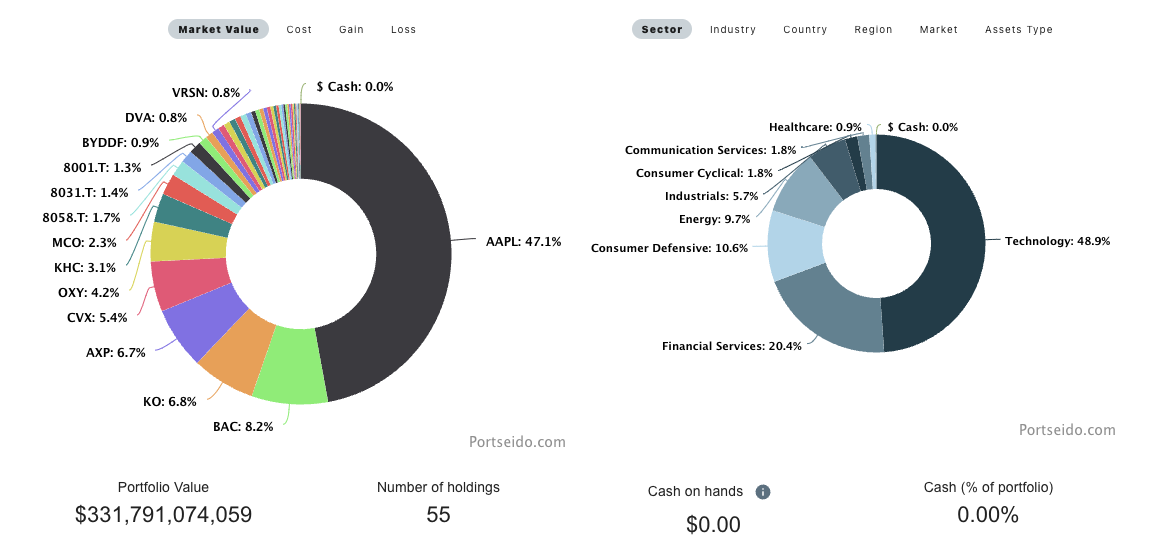
Warren Buffett's Berkshire Hathaway public equity portfolio is a well-known example of a heavily weighted position. The image above shows that portfolio as of November 1st, 2023, excluding cash. With a $156 billion AAPL position in a $331 billion portfolio, the portfolio weight of AAPL is calculated by dividing the position value by the total portfolio value:
Portfolio Weight = ($156 billion / $331 billion) x 100 = 47.1%
Almost half of that portfolio sat in a single company. Note that these figures describe a specific filing date and will have changed since.
Portfolio weight can also be aggregated by sector. Adding together every Berkshire holding classified as financial services, and dividing that total by the $331 billion portfolio value, gives the portfolio's weight in financial services — a clearer view of what the portfolio is really exposed to than any single ticker provides.
Frequently asked questions
Do portfolio weights always add up to 100%?
Yes, when every position is valued on the same date, in the same currency, and cash is included. If your weights do not sum to 100%, the usual causes are a missing account, an uncounted cash balance, or positions priced on different days. Portfolios using margin are the exception: borrowed money can push the weights of invested positions above 100% in total.
Should portfolio weight use market value or cost basis?
Use market value. Portfolio weight measures the exposure you carry today, and today's exposure is set by what the position is worth now, not by what you paid for it. Cost-based weights understate positions that have risen and overstate ones that have fallen — exactly the opposite of the risk picture you need.
How is portfolio weight different from asset allocation?
Portfolio weight is the share of the portfolio held in one specific position, while asset allocation is the share held in each broad asset class, such as stocks, bonds or cash. Asset allocation is effectively the sum of the portfolio weights of everything inside each class, so the two are the same arithmetic applied at different levels of grouping.
Does cash count when calculating portfolio weight?
Include cash in the total portfolio value if you consider it part of your investment portfolio, and exclude it if you do not — but be consistent, and say which basis you used. Excluding a large cash balance inflates every other holding's weight and can make a portfolio look far more concentrated in equities than it really is.
How to track portfolio weight in Portseido
Portseido is a portfolio tracker that keeps the weight of every position current without manual revaluation. It consolidates holdings across multiple brokers and multiple currencies into one portfolio, shows the asset allocation breakdown and the weight of each holding, tracks cost basis, dividends and yield on cost, and calculates time-weighted and money-weighted returns. Transactions can be imported from brokers or from a CSV, and the portfolio can be benchmarked against indices and ETFs.
It suits investors whose holdings are spread over several accounts, where no single broker screen shows the true weight of anything. Portseido tracks and reports on your portfolio; it does not give buy or sell recommendations. There is a free plan, and paid features come with a 14-day trial that does not need a credit card. Try Portseido free