

How many stocks should you own?
Article last updated: September 10, 2026

"How many stocks should I own?" has no single correct answer, but theory and practitioners converge on a narrow band. Portfolio theory points to 20 to 30 stocks as the level where diversification has done most of its work, while several of the most successful investors deliberately hold far fewer. Which end suits you depends on what you know, what you have found, and how much time you can give it.
Key takeaways
- Portfolio theory suggests roughly 20 to 30 stocks capture most of the available diversification benefit, after which each additional stock reduces risk only marginally.
- Owning more stocks reduces diversifiable risk, the risk specific to one company, but cannot reduce non-diversifiable risk, the market-wide risk measured by beta.
- Concentrated investors including Warren Buffett and Charlie Munger argue for owning fewer stocks, on the condition that you genuinely understand each business you own.
- The number of stocks you should own depends on your competency, the quality of the opportunities you have found, and the time you can spend monitoring them.
- A single broad market index fund holds hundreds of companies, so it delivers wider diversification than a 30-stock portfolio without any per-company research.
How many stocks should you own?
Most investors are well served by 20 to 30 stocks, the range where diversification has captured the bulk of its benefit. Investors who research businesses deeply and want concentration hold fewer, sometimes fewer than ten.
The number is a consequence of three things, not a target in itself:
- Competency. How many businesses can you actually understand and follow?
- Opportunities. How many investments have you found that you rate highly enough to fund?
- Resources and time. How many positions can you research and monitor properly?
If the honest answer to all three is "not many", the alternative to a badly researched 30-stock portfolio is a broad market index fund, which supplies diversification across hundreds of companies without per-company analysis.
What does diversification theory say about the number of stocks?
Diversification theory says that adding stocks to a portfolio steadily removes company-specific risk, that the benefit of each additional stock shrinks, and that the process stops at the level of market-wide risk, which no amount of stocks can remove.
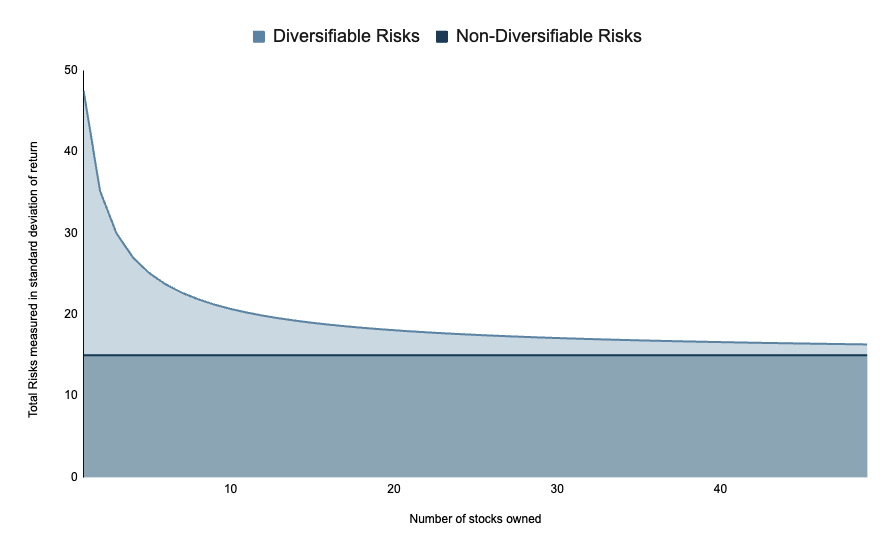
Diversification distinguishes between two types of risk that behave very differently as a portfolio grows.
Diversifiable risks (unsystematic risks)
Diversifiable risks, also called unsystematic risks, are the risks attached to individual companies, such as poor management decisions, industry-specific events, or company-specific issues. Diversification reduces them effectively: in a diversified portfolio, any single company's problems have a limited impact, because not all of your investments are affected in the same way at the same time.
Non-diversifiable risks (systematic risks)
Non-diversifiable risks, also called systematic risks, affect the entire market or a broad sector of it, for example economic factors, interest rate changes, political events, and market sentiment. They are typically measured by the beta of a stock, which quantifies how sensitive it is to market movements, and they cannot be eliminated by adding more stocks.
Why the benefit stops at around 20 to 30 stocks
The more stocks you add, the more company-specific risk you remove, but the effect of each new stock diminishes quickly. Going from 1 stock to 10 removes a large share of diversifiable risk; going from 30 to 40 removes very little, because what remains is mostly market risk. That is why 20 to 30 is the range most commonly suggested. For further reading, we would suggest a research from NDVR where they quantify risks and show how the number works out.
Stock count is not the whole of diversification. Thirty stocks in one sector are less diversified than ten across several, and how you split capital across asset classes usually matters more than the count of names.
What do successful investors say about how many stocks to own?
Many successful investors argue that the ideal number of stocks depends on the investor rather than a formula, and most hold fewer than theory suggests. Their reasoning falls into three factors.
Competency
Warren Buffett emphasises investing in what you understand. He prefers a relatively small number of stocks to keep his portfolio concentrated, but acknowledges that not everyone is comfortable or competent analysing individual businesses. For those who lack the expertise or the inclination for in-depth analysis, owning a broad market index, essentially owning everything, can be a prudent strategy. Charlie Munger, Buffett's long-time business partner, has stated that investing in three outstanding opportunities is sufficient if you truly comprehend what you are doing.
Opportunities
The second factor is the quality of the investment opportunities you discover. Peter Lynch and Warren Buffett both advocate investing heavily in the best opportunities available. Buffett famously said, "To have a super wonderful business and then put money into number 30 or 35 on your list of attractiveness and forgo putting more money into number one just strikes me and Charlie as Madness." Peter Lynch echoes this, suggesting that if you find ten equally attractive opportunities, you should consider investing in all of them. On this view, owning only your best ideas makes sense even when they are few.
Resources and time
The number of stocks you own should also reflect the time you have for managing them. Researching and monitoring businesses takes a real commitment, and the more positions you hold, the thinner that time is spread. Bookkeeping is the part worth automating: Portseido consolidates holdings from every broker into one view and keeps each position's weight, cost basis and return up to date, so the time you spend goes on the businesses rather than the spreadsheet.
Can you own too many stocks?
Yes. Past roughly 30 stocks, each additional position removes very little further risk while adding real monitoring work and diluting the effect of your best ideas.
- Your best ideas stop mattering. In an equally weighted 60-stock portfolio, a position that doubles moves the total by a little over 1%.
- Research quality falls. Time is finite, so more positions usually means shallower work on each.
- You may be paying for an index. A portfolio wide enough to track the market delivers index-like returns, which an index fund provides at lower cost and effort.
- Costs and admin grow. More positions mean more trades, dividend records and tax reporting.
Position sizing often matters more than the count. Two 25-stock portfolios behave completely differently if one is equally weighted and the other has 40% in a single name, which is why portfolio weight is worth tracking alongside the number of holdings.
Do ETFs and index funds change how many stocks you need?
Yes. A single broad market index fund or ETF already holds hundreds or thousands of companies, so it provides more diversification than a 30-stock portfolio and counts for far more than one holding.
This matters when you mix the two. An investor holding a total market ETF as a core plus five individual stocks is already diversified, and those five are best judged as deliberate bets rather than an under-diversified portfolio. Watch for overlap: if your individual stocks are also the largest holdings of your index fund, your real exposure to them is higher than the position sizes suggest.
Frequently asked questions
Is 10 stocks enough to be diversified?
Ten stocks remove a substantial share of company-specific risk, but noticeably less than 20 to 30 do, and the result depends heavily on what those ten are. Ten companies spread across different sectors and geographies are reasonably diversified; ten technology companies are effectively one bet on a single sector.
How many stocks should a beginner start with?
A beginner is usually better served by starting with a broad market index fund, which diversifies across hundreds of companies immediately, and adding individual stocks only for businesses they have genuinely researched. That avoids the common trap of assembling 20 unresearched positions in the belief that the count alone constitutes diversification.
Does the number of sectors matter more than the number of stocks?
Sector spread matters at least as much as stock count, because stocks in the same industry tend to fall together on the same news. Thirty stocks concentrated in one sector carry much of the risk profile of a single position, while 15 across unrelated industries diversify far more effectively.
Can a concentrated portfolio beat the market?
A concentrated portfolio has a wider range of outcomes than a diversified one, so it can beat the market by more and lose to it by more. The only way to know which happened is to measure it: comparing your portfolio against a benchmark index over several years shows whether concentration was rewarded or simply riskier.
How to track a concentrated or diversified portfolio in Portseido
Portseido is a portfolio tracker for investors who want to see what they actually own, whether that is five positions or fifty. It consolidates holdings across brokers and currencies, shows allocation and the weight of every position, calculates time-weighted and money-weighted returns, tracks cost basis, dividends and yield on cost, and reports drawdown so you can see the cost of concentration. You can also benchmark the portfolio against indices and ETFs to test whether your stock count is working.
Portseido tracks and reports on your portfolio; it does not give buy or sell recommendations or tell you how many stocks to hold. There is a free plan, and paid features come with a 14-day trial that does not need a credit card. Try Portseido free
Sources: