

What is Money-Weighted Return (MWR)?
Article last updated: September 10, 2026

Money-weighted return (MWR) is a measure of investment performance that accounts for the size and timing of every cash flow into and out of a portfolio. It is the single rate of return that makes the discounted value of all those cash flows, plus the ending portfolio value, equal the amount originally invested. Money-weighted return is the same number as the internal rate of return (IRR), and it is also called the dollar-weighted return.
Key takeaways
- Money-weighted return (MWR) measures the return an investor personally earned, because it counts the size and timing of every deposit, withdrawal and dividend.
- Money-weighted return is mathematically identical to the internal rate of return (IRR), and is also known as the dollar-weighted return.
- Money-weighted return is calculated with the XIRR function in Excel or Google Sheets, entering contributions as negative amounts and withdrawals, dividends and the ending value as positive amounts.
- Money-weighted return rises when a large deposit lands before a period of strong performance and falls when it lands before a decline, because bigger balances carry more weight.
- Money-weighted return differs from time-weighted return, which ignores the size and timing of cash flows and measures how the investments performed rather than what the investor earned.
What is money-weighted return (MWR)?
Money-weighted return (MWR) is a performance measurement that takes into account every cash flow entering and leaving a portfolio, weighting each period by how much money was invested during it. That is what separates it from a simple percentage gain: a period in which $50,000 was invested influences the result far more than one in which $500 was.
The cash flows involved are contributions, withdrawals, dividends and interest received, and the terminal value of the portfolio. Because larger balances carry more weight, money-weighted return answers the question an individual investor usually cares about, which is what their own money actually earned, timing decisions included.
How do you calculate money-weighted return?
Money-weighted return is calculated by solving for the rate of return that makes the discounted value of all future cash flows, plus the discounted terminal portfolio value, equal the portfolio value at the start.
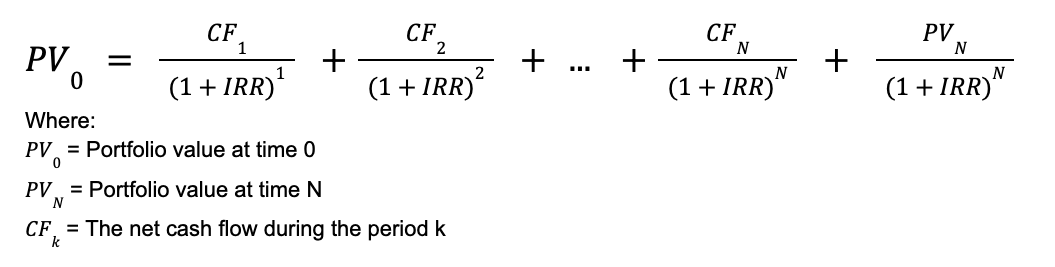
Written out as text, where PV_0 is the portfolio value at time 0, PV_N is the portfolio value at time N, and CF_k is the net cash flow during period k:
PV_0 = CF_1/(1 + IRR)^1 + CF_2/(1 + IRR)^2 + ... + CF_N/(1 + IRR)^N + PV_N/(1 + IRR)^N
The IRR that solves this equation is the money-weighted return. Each CF_k is stated from the investor's point of view: cash received, such as a withdrawal or a dividend, is positive, while cash paid in as a further deposit is negative.
Solving that equation by hand is impractical once there is more than one cash flow, because there is no closed-form answer. In practice it is solved numerically by a spreadsheet, a calculator or a portfolio tracker. You can also use our free money-weighted return calculator.
How do you calculate money-weighted return in Excel or Google Sheets?
Money-weighted return is calculated in Excel or Google Sheets with the XIRR function, which takes a column of dated cash flows and returns the annualised rate that solves for them.
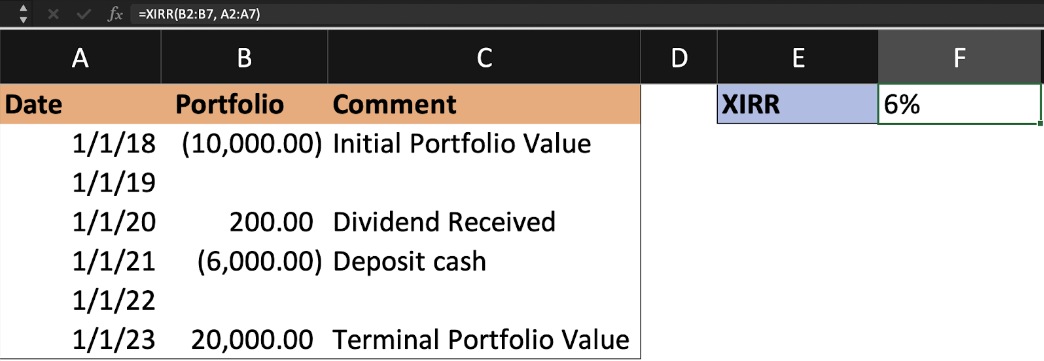
Enter every cash flow with its date, then use =XIRR(values, dates). The signs matter, because XIRR treats the portfolio as a project you fund and are paid back from:
- Enter the initial portfolio value and every later contribution as a negative number, because that is money leaving your pocket.
- Enter dividends, cash withdrawals, sale proceeds and the final portfolio value as positive numbers.
Money-weighted return calculation example
An account opened with $10,000, which received a $200 dividend, took a $6,000 deposit and was worth $20,000 five years later, has a money-weighted return of about 6% a year.
| Date | Cash flow | What it is |
|---|---|---|
| 1 Jan 2018 | -$10,000 | Initial portfolio value |
| 1 Jan 2020 | +$200 | Dividend received |
| 1 Jan 2021 | -$6,000 | Cash deposited |
| 1 Jan 2023 | +$20,000 | Terminal portfolio value |
=XIRR(B2:B7, A2:A7) -> approximately 6%
The account returned $20,200 in total against the $16,000 paid in, but that $4,200 headline gain says nothing about the rate, because the $6,000 was invested for only two of the five years. The money-weighted return of roughly 6% a year is the single rate that reconciles all four dated amounts at once.
Redoing an XIRR every time you deposit, receive a dividend or open an account at another broker is the part most investors quietly abandon. Portseido calculates money-weighted and time-weighted returns from your transaction history automatically, across brokers and currencies, so the figure stays current without spreadsheet maintenance.
Is money-weighted return the same as IRR?
Yes. Money-weighted return is mathematically identical to the internal rate of return (IRR): both are the discount rate that makes the net present value of a series of dated cash flows equal zero.
The name money-weighted return is used in portfolio reporting, while internal rate of return is the term used in corporate finance and project appraisal. The third name for the same figure, dollar-weighted return, describes the mechanism: performance during periods when more money was invested weighs more heavily on the result.
What is the difference between time-weighted and money-weighted returns?
Money-weighted return counts the size and timing of cash flows and measures what the investor earned, while time-weighted return removes cash flows entirely and measures how the investments performed.
Time-weighted return (TWR) splits the period into sub-periods at every deposit or withdrawal, calculates each sub-period's return separately, and chains them together so each sub-period counts equally regardless of the balance at the time. That makes it the fair way to score an investment manager who does not control when clients pay in.
| Money-weighted return | Time-weighted return | |
|---|---|---|
| Cash flow size | Counted | Ignored |
| Cash flow timing | Counted | Sets sub-period boundaries only |
| Question answered | What did I actually earn? | How did the investments perform? |
| Typical use | Judging your own results, contributions included | Comparing funds, managers and benchmarks |
The two figures answer different questions and will normally differ for the same account. A fuller comparison of simple return, time-weighted return and money-weighted return works through the same portfolio under all three methods.
When should you use money-weighted return?
Use money-weighted return when you control the timing of your own contributions and want a figure that grades those decisions along with the investments themselves.
- You choose when to invest. If you deliberately hold cash back and deploy it when opportunities appear, money-weighted return is what rewards or punishes that judgement.
- You want your personal outcome. Money-weighted return is the closest thing to a personal rate of return on the money you committed.
- The account has irregular cash flows. Money-weighted return handles uneven amounts on uneven dates, which a simple percentage gain cannot.
The limitation of money-weighted return is that it grades cash-flow timing even when the timing was not an investment decision. An investor who receives an annual work bonus and invests it immediately gets a money-weighted return shaped by their employer's payroll calendar. In that case the number reflects luck rather than skill, and time-weighted return is the fairer read. Money-weighted return is one of four common ways to calculate portfolio return, and many investors report it next to time-weighted return rather than choosing one.
Frequently asked questions
Can money-weighted return be negative?
Yes. Money-weighted return is negative whenever the total value received back, including the ending portfolio value, is worth less than the amounts paid in once timing is accounted for. A negative money-weighted return can occur even in a portfolio whose investments rose, if most of the money was contributed shortly before a decline.
Why is my money-weighted return different from my time-weighted return?
Money-weighted return and time-weighted return differ because money-weighted return weights each period by the amount invested and time-weighted return weights every period equally. If your money-weighted return is higher, your larger contributions happened to be invested during stronger periods. If it is lower, the bigger balances were exposed to the weaker periods.
Does money-weighted return include dividends?
Yes. Dividends and interest received are cash flows into the calculation, entered as positive amounts on the date they were paid. Dividends reinvested inside the portfolio need no separate entry, because they are already reflected in the terminal portfolio value. Leaving dividends out understates the return of income-paying holdings.
Why does XIRR return an error?
XIRR returns an error most often because the cash flows all share the same sign, because no date column was supplied, or because the values and dates ranges are different lengths. XIRR needs at least one negative and one positive amount to solve for a rate. Highly irregular flows can also need a starting guess as the function's third argument.
How to track money-weighted return in Portseido
Portseido is a portfolio tracker that calculates money-weighted return, also known as XIRR, from your transaction history, so every dated deposit, withdrawal and dividend is already in the calculation. It consolidates holdings across brokers and currencies, reports simple return, time-weighted return and money-weighted return side by side, tracks cost basis, dividends and yield on cost, and benchmarks the portfolio against indices and ETFs. Transactions import from brokers or from a CSV.
Portseido tracks and reports on your portfolio; it does not give buy or sell recommendations. There is a free plan, and paid features come with a 14-day trial that does not need a credit card. Try Portseido free