

What is Time-Weighted Return (TWR)?
Article last updated: September 10, 2026

Time-weighted return (TWR) is a measure of investment performance that splits a period into sub-periods at every deposit or withdrawal, calculates each sub-period's return separately, and chains them together so every sub-period counts equally. Because the amount of money in the portfolio never changes the weighting, time-weighted return shows how the investments performed rather than how well the timing of contributions worked out.
Key takeaways
- Time-weighted return (TWR) measures investment performance by calculating each sub-period's return separately and multiplying those returns together, so every period carries equal weight whatever the portfolio was worth at the time.
- Time-weighted return is calculated as (1 + R1) x (1 + R2) x ... x (1 + Rn) - 1, where each R is the return of one sub-period between cash flows.
- Time-weighted return removes the effect of deposits and withdrawals, which is why it is the standard basis for reporting fund and investment manager performance.
- Time-weighted return differs from money-weighted return, which builds in the size and timing of every cash flow and so measures what the investor personally earned.
- Time-weighted return differs from CAGR, because CAGR assumes one constant growth rate across the whole period instead of chaining each sub-period's actual return.
What is time-weighted return (TWR)?
Time-weighted return (TWR) is a measure of investment performance that calculates the return for each time period separately and then combines those returns with equal weight. The name comes from that equal weighting: each slice of time counts the same, whatever the portfolio happened to be worth during it.
A portfolio's value changes for two reasons: the investments moved, or money was added or taken out. Time-weighted return separates the two by cutting the timeline at every cash flow and compounding the slices together, so deposits and withdrawals set the sub-period boundaries but never enter the return figures themselves.
That property is why time-weighted return is the reporting standard for funds and investment managers, who do not choose when their clients deposit or redeem.
How do you calculate time-weighted return?
Time-weighted return is calculated by splitting the measurement period into sub-periods at every cash flow, computing each sub-period's return, adding one to each, multiplying them together, and subtracting one from the product.
Time-weighted return formula
The time-weighted return formula has two parts: one that computes the return of a single sub-period from the portfolio values and the cash flow at its start, and one that chains those sub-period returns into a figure for the whole period.
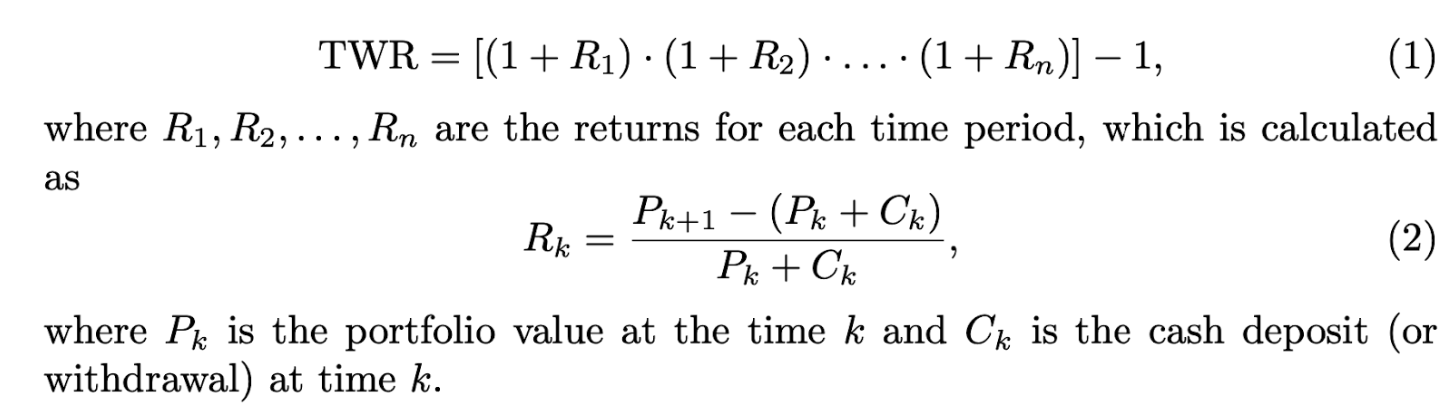
Written out as text, where P_k is the portfolio value at time k and C_k is the cash deposited or withdrawn at time k:
R_k = (P_k+1 - (P_k + C_k)) / (P_k + C_k)

TWR = [(1 + R_1) x (1 + R_2) x ... x (1 + R_n)] - 1
A withdrawal is entered as a negative C_k. When no money moved at time k, C_k is zero and the sub-period return collapses to the end value divided by the start value, minus 1.
Time-weighted return calculation example
A portfolio that begins at $10,000, takes a $1,000 deposit, runs through four sub-periods and ends at $12,000 has a time-weighted return of 18.58%.
| Sub-period | Starting value | Cash in/out | Value at end | Sub-period return |
|---|---|---|---|---|
| 1 | $10,000 | +$1,000 | $12,000 | 9.09% |
| 2 | $12,000 | 0 | $13,200 | 10.00% |
| 3 | $13,200 | 0 | $12,500 | -5.30% |
| 4 | $12,500 | -$1,000 | $12,000 | 4.35% |
Sub-period 1 shows how a cash flow is handled. The $1,000 deposit is added to the $10,000 starting value, so the return is (12,000 - 11,000) / 11,000 = 9.09%, not (12,000 - 10,000) / 10,000 = 20%. Treating the deposit as a gain would be the single most common mistake in the calculation.
Chaining the four sub-period returns gives the time-weighted return for the whole period:
TWR = (1 + 0.0909) x (1 + 0.1000) x (1 - 0.0530) x (1 + 0.0435) - 1 = 0.1858 = 18.58%
The portfolio ended $2,000 above where it started, but $1,000 of that was a deposit and $1,000 was later withdrawn, so the raw change in value says almost nothing. The 18.58% is what the investments did once the cash flows are removed.
How do you calculate time-weighted return in Excel?
Time-weighted return is calculated in Excel by listing each sub-period's opening value and cash flow, computing the sub-period returns in one column, then multiplying (1 + return) across that column and subtracting 1.
- Input the portfolio value at the start of each sub-period, with any cash flow at that point, positive for a deposit and negative for a withdrawal.
- Calculate each sub-period's return as the next opening value divided by the current opening value plus that cash flow, minus 1.
- Chain the column with a formula such as
=(1+D2)*(1+D3)*(1+D4)*(1+D5)-1.
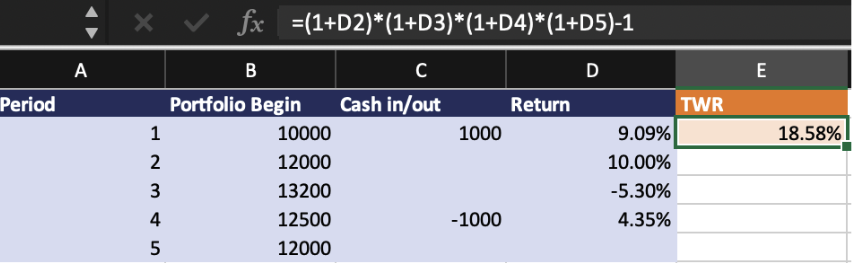
The spreadsheet stops being practical on a real portfolio, because a correct time-weighted return needs the portfolio revalued on every deposit, withdrawal and transfer date, at every broker you hold. Portseido calculates time-weighted return from your imported transaction history automatically, across brokers and currencies, so the sub-period boundaries stay correct without rebuilding the sheet after each trade.
Alternatively, you can try calculating time-weighted return with our free time-weighted return calculator.
Is time-weighted return the same as CAGR?
No. Time-weighted return and compound annual growth rate (CAGR) are related but not identical: CAGR describes a single constant annual growth rate over one unbroken period, while time-weighted return chains together the separately measured returns of many sub-periods.
The two coincide in one case: for a portfolio with no deposits or withdrawals, the annualised time-weighted return is the CAGR. Once cash flows exist they diverge, because a CAGR taken from start and end values alone counts deposits as investment gains.
What is the difference between time-weighted return and money-weighted return?
Time-weighted return ignores the size and timing of cash flows and measures how the investments performed, while money-weighted return builds cash flows in and measures what the investor actually earned.
Money-weighted return, also called the internal rate of return (IRR), is the single rate that makes the present value of every cash flow plus the ending portfolio value equal zero. It therefore rises when a large deposit lands before a rally and falls when one lands before a decline.
| Time-weighted return | Money-weighted return | |
|---|---|---|
| Cash flow size | Ignored | Counted |
| Cash flow timing | Sets sub-period boundaries only | Counted |
| Question answered | How did the investments perform? | What did I actually earn? |
| Typical use | Comparing funds, managers and benchmarks | Judging your own results, contributions included |
Neither figure is more correct than the other; the full comparison of simple return, time-weighted return and money-weighted return sets out when each one is the honest answer.
What is the difference between ROI and time-weighted return?
Return on investment (ROI) divides total gain by the amount invested in a single step, while time-weighted return measures each sub-period separately and compounds those returns together. Neither rewards a larger balance, but ROI is distorted by mid-period deposits, because new money inflates the denominator without having had time to earn anything. Time-weighted return is one of four common ways to calculate portfolio return, and ROI, under the name simple return, is another.
When should you use time-weighted return?
Use time-weighted return whenever you want to judge investment performance separately from the timing of contributions, and above all when you did not control that timing.
- Comparing yourself with an index. Benchmarking a portfolio against an index or ETF only works if your figure is cash-flow neutral, as the index's is.
- Comparing funds or managers. Published fund returns are time-weighted, so it is the like-for-like comparison.
- Regular contributions. For an investor paying in monthly, it separates the investing decisions from the payment schedule.
Time-weighted return has one real weakness: because every sub-period counts equally, a small early portfolio counts as much as a large later one. A portfolio worth $1,000 that gained 50%, then took a $2,000 deposit and lost 20%, still shows a positive time-weighted return while the investor is down in cash terms. That is why a full portfolio performance evaluation reports both return methods alongside risk measures.
Frequently asked questions
Can time-weighted return be negative?
Yes. Time-weighted return is negative whenever the chained product of the sub-period returns is less than 1, meaning the investments lost value over the period on a cash-flow-neutral basis. A single very poor sub-period can drag the whole chain negative even if most sub-periods were positive, because the sub-period returns are multiplied rather than averaged.
Does time-weighted return include dividends?
Yes, when calculated properly. Dividends and interest earned inside the portfolio are investment returns, so they belong in the sub-period's ending value or in its income term. Only cash you personally add or remove counts as a cash flow that starts a new sub-period. Reinvested dividends therefore need no special handling at all.
How do you annualise a time-weighted return?
Annualise a time-weighted return with ((1 + TWR) ^ (1 / Number of Years)) - 1. A time-weighted return of 18.58% earned over two years annualises to roughly 8.9% a year. Annualising matters before any comparison, because fund and index returns are quoted annually and comparing a multi-year figure against a one-year one overstates performance.
How to track time-weighted return in Portseido
Portseido is a portfolio tracker that calculates time-weighted return from your transaction history, so the sub-period boundaries and revaluations happen automatically. It consolidates holdings across brokers and currencies, reports simple return, time-weighted return and money-weighted return side by side, tracks cost basis, dividends and yield on cost, and benchmarks the portfolio against indices and ETFs so the time-weighted figure has something to be measured against. Transactions import from brokers or from a CSV.
Portseido tracks and reports on your portfolio; it does not give buy or sell recommendations. There is a free plan, and paid features come with a 14-day trial that does not need a credit card. Try Portseido free