

Time-Weighted (TWR) vs Money-Weighted Return (MWR)
Article last updated: September 10, 2026
Simple return, time-weighted return and money-weighted return are three ways of turning the same portfolio into a percentage, and they routinely disagree. The reason they disagree is deposits and withdrawals: each method treats new money differently, so choosing between them is really a choice about whether you want to measure the investments, the investor, or just the bookkeeping.
Here is the example used throughout this article. You invest $1,000 and a year later it is worth $1,500, a gain of $500. You then add a $2,000 bonus, taking the portfolio to $3,500. A week after that the portfolio is up another 1%, at $3,535. What is your return?
Key takeaways
- Simple return divides total gain by total invested capital, so it ignores how long the money was invested and drops sharply the moment new cash is added.
- Time-weighted return splits the period at every cash flow, measures each sub-period separately and chains the results, so deposits and withdrawals cannot distort it.
- Money-weighted return is the rate that discounts every dated cash flow back to the amount invested, so it counts both the size and the timing of contributions.
- The three methods give the same answer only when no money enters or leaves the portfolio after the initial investment.
- Use time-weighted return when you do not control the timing of cash flows, and money-weighted return when you do and want that judgement graded.
What is the difference between simple return, time-weighted return and money-weighted return?
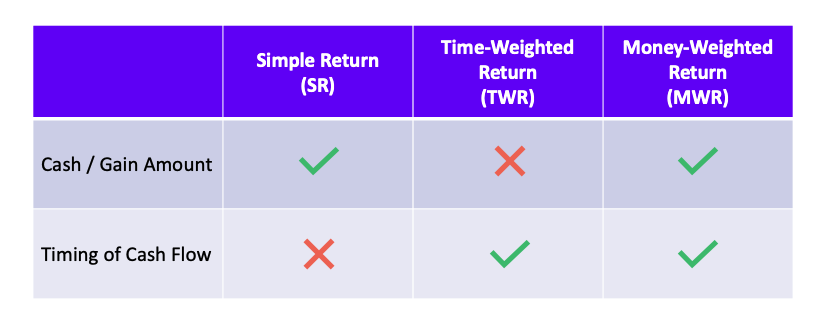
Simple return measures bookkeeping gain, time-weighted return measures how the investments performed, and money-weighted return measures what the investor earned. The difference between them is entirely in how each one treats deposits and withdrawals.
| Method | Counts cash flow size | Counts cash flow timing | What it measures |
|---|---|---|---|
| Simple return (SR) | Yes | No | The gain relative to what you put in |
| Time-weighted return (TWR) | No | Only as sub-period boundaries | How the investments performed |
| Money-weighted return (MWR) | Yes | Yes | What you personally earned |
Applied to the same portfolio, $1,000 that grew to $1,500 over a year, then took a $2,000 deposit and rose 1% in a week to $3,535, the three methods give 17.83%, 51.5% and roughly 50.7% a year respectively. None of the three is wrong; they are answers to three different questions.
What is simple return (SR)?
Simple return (SR) is the total gain on a portfolio divided by the total capital invested in it, with no adjustment for how long that capital was invested.
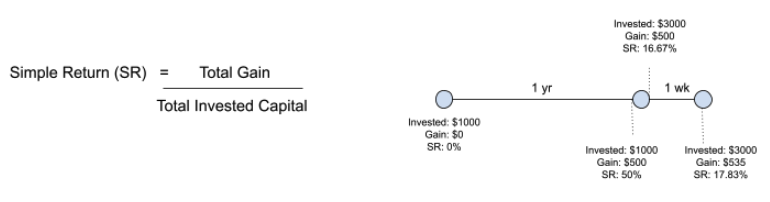
Simple Return = Total Gain / Total Invested Capital
Follow the running example through simple return and the problem appears immediately. After one year, $1,000 has become $1,500, so simple return is 500 / 1,000 = 50%. Add the $2,000 bonus and total invested capital becomes $3,000 while the gain is still $500, so simple return falls to 500 / 3,000 = 16.67%. A week later the portfolio is at $3,535, so the gain is $535 and simple return is 535 / 3,000 = 17.83%.
Nothing about the investing got worse in that moment. Simple return collapsed because it does not care how long the capital has been in the portfolio, and the last $2,000 had been there for a week. When money moves in and out, simple return is a bookkeeping figure rather than a measure of investment ability.
What is time-weighted return (TWR)?
Time-weighted return (TWR) ignores the size of the portfolio and computes the return of each sub-period separately, then compounds those sub-period returns into a single figure for the whole period.

TWR = [(1 + R_1) x (1 + R_2) x ... x (1 + R_n)] - 1
Each R is the return of one sub-period, with the sub-periods split at every deposit or withdrawal. In the running example there are two sub-periods: the first year, in which $1,000 became $1,500 for a return of 50%, and the following week, in which the portfolio rose 1%.
TWR = (1 + 0.50) x (1 + 0.01) - 1 = 0.515 = 51.5%
Over 372 days that annualises to about 50.3% a year. Time-weighted return is the better measure of investing ability here, because it averages performance over time regardless of how much money happened to be invested. You can also try our free TWR calculator.
What are the limitations of time-weighted return?
The limitation of time-weighted return is that by ignoring portfolio size it can report a healthy gain on a portfolio that actually lost money.
Take the same portfolio, now worth $3,500 after a $1,000 start and a $2,000 deposit, and suppose it falls 20% over the following year to $2,800. The investor has paid in $3,000 in total and holds $2,800, a cash loss of $200. Time-weighted return over the two years is nevertheless positive:
TWR = (1 + 0.50) x (1 - 0.20) - 1 = 0.20 = 20%
The 50% gain came when only $1,000 was invested and the 20% loss came when $3,500 was, but time-weighted return gives both periods equal weight. That is the correct behaviour when you are grading a manager who does not control the deposits, and misleading when you are grading your own outcome.
What is money-weighted return (MWR)?
Money-weighted return (MWR), also called the dollar-weighted return or the internal rate of return (IRR), is the single rate of return at which the discounted value of everything you paid in equals the discounted value of everything you got back, including the portfolio's current value.
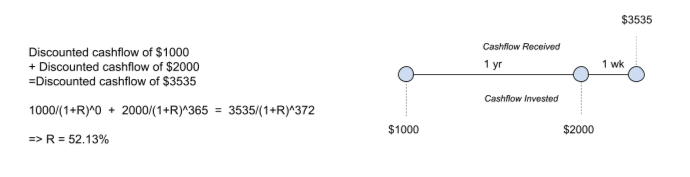
Sum of Cash Invested_k / (1 + R)^(Days_k / 365) = Sum of Cash Received_k / (1 + R)^(Days_k / 365)
Days_k is the number of days from the first cash flow to cash flow k, and R is the annual rate being solved for. In the running example, $1,000 goes in on day 0, $2,000 goes in on day 365, and the portfolio is worth $3,535 on day 372:
1000/(1+R)^(0/365) + 2000/(1+R)^(365/365) = 3535/(1+R)^(372/365)
R = 50.7% a year
That is slightly above the annualised time-weighted return of 50.3%, because the strong final week, worth about 68% annualised, happened while the larger balance was invested and money-weighted return gives it more weight. There is no formula that solves for R directly, so it is found numerically, in practice by the XIRR function in a spreadsheet or by our free MWR calculator.
What are the limitations of money-weighted return?
The limitation of money-weighted return is that it grades the timing of cash flows even when those cash flows had nothing to do with investing.
Money-weighted return gives the most weight to the periods when the portfolio was largest, which is fair if you deliberately raised cash and deployed it when opportunities appeared. It is not fair when the deposits were driven by your payroll. An investor who invests a work bonus the day it arrives posts a high money-weighted return whenever markets rise afterwards, and a low one when they do not, without a single decision of theirs changing.
Recomputing these figures by hand after every trade, dividend and transfer is where most investors give up. Portseido calculates simple return, time-weighted return and money-weighted return from your transaction history across brokers and currencies, so all three sit side by side without spreadsheet maintenance.
When do simple return, time-weighted return and money-weighted return agree?
Simple return, time-weighted return and money-weighted return give the same answer when no money enters or leaves the portfolio after the initial investment.
With a single deposit at the start, there is only one sub-period to chain, only one cash flow to discount, and only one figure for invested capital, so all three methods reduce to the same calculation. Every difference between them is created by later cash flows.
Which return method should you use?
Use time-weighted return when you do not control the timing of cash flows, and money-weighted return when you do and want those decisions counted in the result.
- Money-weighted return suits an investor who chooses when to deploy capital, for example by holding cash back until valuations improve. It grades the whole decision, including timing.
- Time-weighted return suits an investor whose contributions are fixed by a salary or a schedule, and is the correct basis for comparing a portfolio against an index or ETF, since an index has no cash flows.
- Simple return suits bookkeeping: what did I put in, what is it worth now.
The two questions are different enough that many investors track both. If you want to know how your investments did over a period, look at time-weighted return; if you want to know what your money earned, look at money-weighted return. Both are among the four standard methods for calculating portfolio return.
Frequently asked questions
Which return figure does my broker show me?
Most brokerage statements show a simple return, the gain divided by the amount invested, because it is the easiest figure to derive from account records. Funds and managed accounts usually report time-weighted return, since that is the reporting standard for performance. Check the basis before comparing two figures, because a difference in method can be larger than a difference in performance.
Should dividends be included in all three methods?
Yes. Dividends and interest are part of the return in every method, and leaving them out understates income-paying holdings. In simple return they belong in the total gain, in time-weighted return they belong in the sub-period's ending value, and in money-weighted return they are entered as a positive cash flow on the date they were paid.
Do these returns need to be annualised before comparing them?
Yes, whenever the periods differ. Money-weighted return is already an annual rate because it is solved as one, while simple return and time-weighted return are cumulative over whatever period you measured. Convert a cumulative figure with ((1 + Return) ^ (1 / Number of Years)) - 1 before setting it beside an annual benchmark figure.
Can time-weighted and money-weighted return point in opposite directions?
Yes, and it is a useful signal. A positive time-weighted return with a negative money-weighted return means the investments performed adequately but most of your money arrived before the weaker stretches. The reverse means good timing rescued mediocre holdings. Seeing both figures separates the quality of what you own from when you bought it.
How to see all three returns in Portseido
Portseido is a portfolio tracker that reports simple return, time-weighted return and money-weighted return for the same portfolio, so you can read all three without choosing one in advance. It consolidates holdings across brokers and currencies, tracks cost basis, dividends and yield on cost, shows allocation and drawdown, and benchmarks the portfolio against indices and ETFs. Transactions import from brokers or from a CSV, which is what keeps the cash-flow dates behind these calculations accurate.
Portseido tracks and reports on your portfolio; it does not give buy or sell recommendations. There is a free plan, and paid features come with a 14-day trial that does not need a credit card. Try Portseido free