

Investing and the game of chance
Article last updated: September 10, 2026
Investing and trading are games of chance, unlike chess and other deterministic games, which means there is a random element involved in the game. That is frustrating, but it is the reality: you can make the right decisions and still lose money. This article breaks the game into its components, starting with a single coin flip and building up to investing, to show what an investor can actually control.
Key takeaways
- Investing is a game of chance rather than a deterministic game, so a correct decision can still produce a loss and a bad decision can still produce a gain.
- Every bet, including every investment, reduces to two components: the set of possible outcomes and the probability of each one.
- A bet is worth taking when its expected value is greater than zero, which happens when the odds favour you, when the payout is asymmetric in your favour, or both.
- Risk of ruin is the chance of losing enough capital that recovery becomes impossible, and it is the reason a high expected return does not justify betting everything on one position.
- Investing is harder than a coin flip because nobody tells you the probabilities or the payouts, and the range of outcomes is continuous rather than two-sided.
Is investing a game of chance?
Investing is a game of chance, in the specific sense that outcomes are drawn from a probability distribution rather than determined by the quality of your decision alone. A well-researched position can lose money and a careless one can make money, and over a small number of decisions you cannot tell the two apart from results.
This is what separates investing from chess. In chess, a better move produces a better position every time. In investing, a better decision produces a better expected outcome, which only reveals itself across many decisions. Everything that follows is about playing a probabilistic game well: estimating the odds, sizing the bet, and surviving long enough for the odds to matter.
What can a coin flip teach you about investing?
A coin flip strips an investment down to its two irreducible components: the outcomes and their probabilities. In the simplest version of the game, a coin with a known chance of landing heads or tails is offered, and the player decides whether to bet. Heads wins money, tails loses money, and the only job is to assess whether the probability and the payout are on the player's side.
Coin with 50% chance to land heads and 50% chance to land tails
* Land Heads => Player wins $ 10
* Land Tails => Player loses $ 10
This is a fair game, meaning that on average players gain nothing from betting on it. Toss the coin once and you either win $10 or lose $10. Toss it enough times and the profit heads toward $0 on average.
Coin with 51% chance to land heads and 49% chance to land tails
* Land Heads => Player wins $ 10
* Land Tails => Player loses $ 10
This is an unfair game that benefits the player. The chance of being at a profit after 100 tosses rises from 0.46 in the fair game to 0.54, on a one percentage point edge.
Coin with 50% chance to land heads and 50% chance to land tails
* Land Heads => Player wins $ 10
* Land Tails => Player loses $ 15
This is also an unfair game, but it worsens the player's odds of being profitable in the long term. The chance of being at a profit after 100 tosses falls to 0.02, even though the coin itself is perfectly fair. The payout asymmetry did all the damage.
What makes a bet worth taking?
A bet is worth taking when its expected value is greater than zero, which requires either favourable odds, a favourable payout ratio, or a combination of the two. Expected value is the sum of each outcome multiplied by its probability, and it is the only test the two-component game needs.
The characteristics of a game worth playing are:
- High chance of winning, low chance of losing.
- High prize when you win, low penalty when you lose.
Only one of the two statements has to be true. An investment might have a low chance of paying off, but if it pays a great deal when it does and costs little when it does not, the asymmetry can more than offset the low hit rate. This is the arithmetic behind venture-style investing and behind concentrated bets generally, and it is why hit rate alone is a poor way to judge an investor.
How do you allocate limited capital across many opportunities?
With limited capital and many positive-expected-value opportunities, allocation becomes the decision that matters, because you cannot fund every good bet. Change the coin game so that multiple coins are tossed at once and each one costs money upfront, and the game is no longer about identifying a good coin. It is about ranking them and dividing capital between them.
That ranking cannot be done on expected return alone, because expected return says nothing about what happens on the bad outcome. Position size, and therefore how much weight each holding carries in the portfolio, is where risk actually enters. How many positions to hold in the first place is the same question asked from the other direction.
What is risk of ruin?
Risk of ruin is the risk that an investment loses so much that recovery becomes impossible. It is game over in investing, and it is the one risk that cannot be traded off against return, because a ruined player does not get to play the next round. Consider two coins:
COIN 1
Coin with 50% chance to land heads and 50% chance to land tails
* Land Heads => Player receives 20% of the capital
* Land Tails => Player loses 10% of the capital
COIN 2
Coin with 50% chance to land heads and 50% chance to land tails
* Land Heads => Player receives 200% of the capital
* Land Tails => Player loses 100% of the capital
COIN 1 has an expected return of 5% (half of +20% plus half of -10%). COIN 2 has an expected return of 50% (half of +200% plus half of -100%). On expected return alone COIN 2 looks like a clear choice, and some players would put every dollar into it.
But COIN 2 carries a 50% chance of losing the entire capital. Imagine building a fortune over thousands of tosses and having a single flip erase it. That is risk of ruin, and it is why capital allocation aims at the best risk-adjusted return rather than the highest expected return. In a portfolio, the observable version of this risk is maximum drawdown, the largest peak-to-trough fall your capital has suffered.
In the multiple-coin game, then, each opportunity must be assessed individually on expected value and then compared with the others on both risk and reward. The goal is to maximise return while minimising the chance of being ruined.
Why is investing harder than a coin flip?
Investing is harder than a coin flip because nobody tells you the probabilities or the payouts, and the outcomes are continuous rather than binary. Every component of the coin games still exists in investing, but all of them are hidden.
- Unknown probability. No one states the chance that a business succeeds.
- Unknown payout. No one states how much you gain if it does or lose if it does not.
- Continuous outcomes. A coin has two results; an investment has an unbounded range of them.
- Limited funds. Capital still has to be split across the opportunities you find.
The job of an investor or trader is therefore to estimate those hidden components and make decisions from the estimates. Methods differ, from discounted cash flow to comparing performance against a benchmark index, but the goal is identical: study each investment, estimate its outcomes, and allocate capital to achieve the best risk-adjusted return.
What should an investor do when a good decision loses money?
When a good decision loses money, treat it as a data point about the process, not a verdict on the decision, and change the process only if the reasoning was wrong rather than the outcome. Plenty can go wrong: the risks can be miscalculated, the returns can be overestimated, or the allocation can be mis-sized. And even when all of that is right, chance can still go against you.
Separating the two requires a record. Without one, memory rewrites the reasoning to match the result, and every loss looks avoidable in hindsight. Keeping a full history of positions, their sizes and what each one contributed is the practical form of this: Portseido builds that history from your transactions and reports each holding's return and weight, so you can look back at what you actually decided rather than what you remember deciding.
What is left is to learn from the outcome and improve the process, which is the only part of a game of chance that is genuinely under your control.
Frequently asked questions
Is investing the same as gambling?
Investing and gambling both involve probabilistic outcomes, but they differ on expected value and time horizon. Casino games are constructed with negative expected value for the player, so playing longer guarantees a worse result. Broad equity ownership has historically carried positive expected value, so a longer horizon works in the investor's favour rather than against it.
What is expected value in investing?
Expected value is the probability-weighted average of every possible outcome of an investment. A position with a 50% chance of gaining 20% and a 50% chance of losing 10% has an expected value of +5%. Expected value tells you whether a bet is worth taking at all, but says nothing about how large the bet should be.
How do you avoid risk of ruin?
Avoid risk of ruin by sizing positions so that no single loss can end the game, avoiding leverage that can force liquidation, and keeping enough liquidity that you are never forced to sell at the bottom. The test is simple: if this position went to zero tomorrow, could the portfolio still recover? If the answer is no, the position is too large.
How many decisions does it take to tell skill from luck?
Judging an investment process on a handful of outcomes is unreliable, because in a probabilistic game short runs of results are dominated by chance. Several years of results across many positions, compared against a relevant benchmark, is the minimum that begins to separate skill from luck. This is also why a single spectacular year proves very little.
How to track your investing results in Portseido
If investing is a game, consider Portseido a scoreboard.
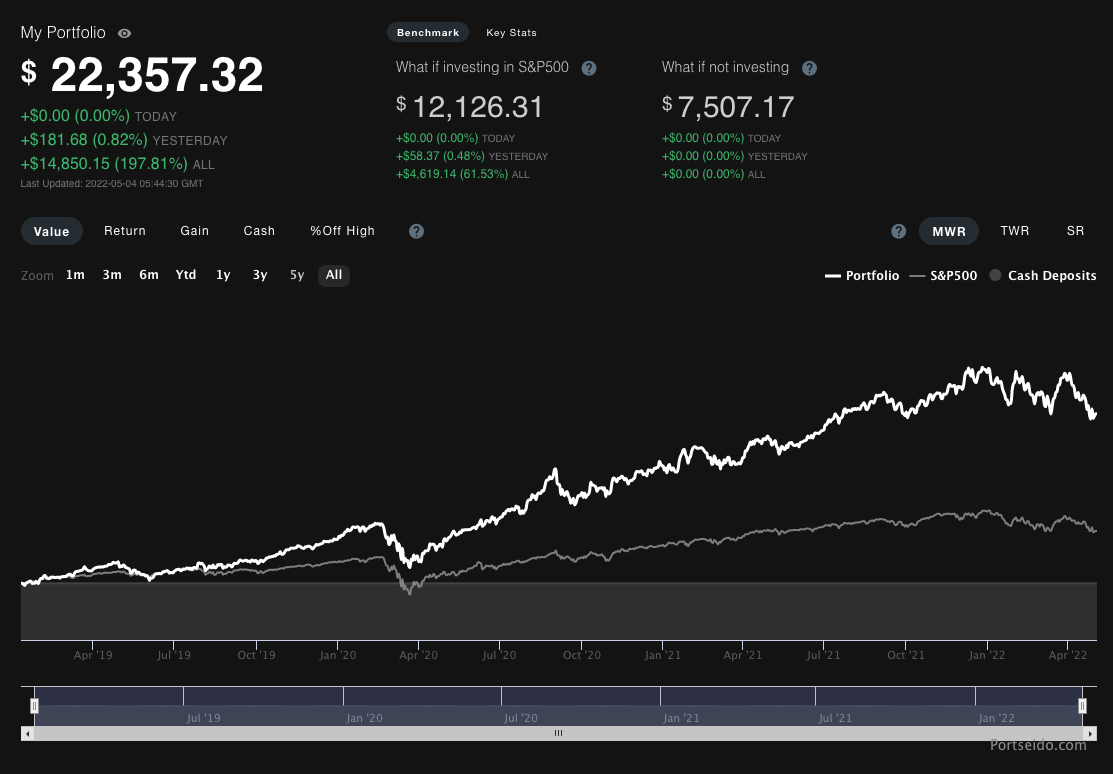
Portseido is a portfolio tracker for investors who want to see what their decisions actually produced. It consolidates holdings across brokers and currencies, calculates time-weighted and money-weighted returns, tracks cost basis, dividends and yield on cost, and reports allocation and drawdown, which is the closest observable proxy for how near a portfolio came to ruin. It also benchmarks the portfolio against indices and ETFs, so results can be judged against an alternative rather than in isolation.
Portseido tracks and reports on your portfolio; it does not give buy or sell recommendations. There is a free plan, and paid features come with a 14-day trial that does not need a credit card. Try Portseido free